Project Work Packages
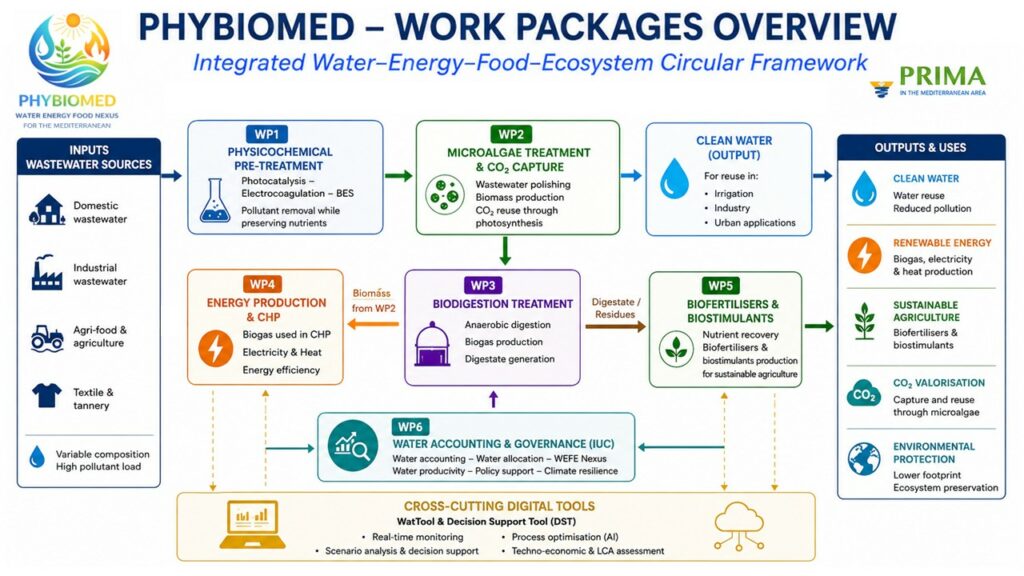
The PHYBIOMED project is structured around six interconnected technical Work Packages (WPs), supported by dedicated activities for dissemination, communication, management, and coordination. Together, these WPs create an integrated framework that transforms wastewater into clean water, renewable energy, biofertilizers, and valuable resources while supporting sustainable water governance and circular economy principles.
WP1 – Physicochemical Pre-Treatment of Wastewater
WP1 focuses on the development of advanced physicochemical treatment processes, including photocatalysis, electrocoagulation, electrochemical advanced oxidation processes, and bioelectrochemical systems. The objective is to efficiently remove pollutants and micropollutants while preserving essential nutrients required for downstream biological treatments. This work package provides the first purification stage for a wide range of domestic, industrial, agricultural, and agri-food wastewaters.
WP2 – Microalgae Treatment and CO₂ Capture
WP2 develops innovative biological treatment processes based on microalgae cultivation. Microalgae remove residual nutrients and contaminants from pre-treated wastewater while producing valuable biomass. At the same time, captured CO₂ is reused through photosynthesis, contributing to carbon valorization and reducing greenhouse gas emissions. The generated biomass serves as feedstock for subsequent biodigestion and biofertilizer production processes.
WP3 – Biodigestion Treatment and Sustainability Assessment
WP3 converts microalgal biomass and organic residues into renewable energy through anaerobic digestion. The process produces biogas, which can be used for electricity and heat generation, as well as digestate that can be further valorized as biofertilizers and biostimulants. This work package also evaluates the technical, economic, and environmental sustainability of the integrated treatment chain through techno-economic analyses and Life Cycle Assessment (LCA).
WP4 – Energy Production, Digital Tools and Optimization
WP4 focuses on renewable energy generation and system optimization. Biogas produced in WP3 is converted into electricity and heat through Combined Heat and Power (CHP) systems. This work package also develops two innovative digital tools: WatTool, a real-time monitoring and optimization platform, and the Decision Support Tool (DST), which helps stakeholders select the most suitable wastewater treatment and water reuse strategies according to local conditions and needs.
WP5 – Biofertilizers and Biostimulants
WP5 aims to transform microalgae-derived biomass and digestate into innovative biofertilizers and biostimulants for sustainable agriculture. Advanced formulations are developed and tested under laboratory, greenhouse, and field conditions to improve crop productivity, nutrient efficiency, stress resistance, and water-use efficiency while reducing reliance on synthetic fertilizers.
WP6 – Water Accounting and Governance
WP6 develops innovative water accounting methodologies and governance tools to improve water allocation and management. By integrating wastewater availability, treatment performance, freshwater consumption, and climate-related risks, this work package supports informed decision-making and strengthens the Water–Energy–Food–Ecosystem (WEFE) Nexus approach. Case studies in Mediterranean countries will demonstrate the benefits of improved water governance and sustainable resource management.
WP7 – Dissemination, Communication and Exploitation
WP7 ensures the effective dissemination of project results to scientists, industries, policymakers, water managers, and local communities. Activities include website development, scientific publications, workshops, stakeholder engagement, communication campaigns, and exploitation strategies to maximize the long-term impact and adoption of PHYBIOMED innovations.
WP8 – Project Management and Coordination
WP8 oversees the overall management, coordination, financial monitoring, and quality assurance of the project. It ensures effective collaboration among consortium partners, timely delivery of project objectives, risk management, and compliance with PRIMA requirements throughout the project lifetime.
Together, these work packages establish a complete circular framework in which wastewater is transformed into clean water, renewable energy, biofertilizers, and valuable resources, contributing to sustainable development and resilience across the Mediterranean region.